STORM Platform · Technical Vulnerability Management

Prioritize what to fix—and prove the follow-through.

Bring vulnerability findings into one workflow, connect them to Cartography assets, prioritize with CVSS and known-exploitation context, and track remediation against owners and SLAs.

STORM currently supports findings from vulnerability scanners such as Tenable Nessus and Microsoft Defender, centralising and governing results alongside your existing scanners.

Vulnerability postureAssets linked
SLA
Priorities in context

Severity, known exploitation, asset relationships and remediation progress brought into one governed view.

OpenCritical
TrackHigh
KEVClassified
TrendResolved
Asset-correlated findingOwner assigned · SLA tracked
In progress
Severity-triggered ticketDue date and remediation workflow
Attention
Nessus + DefenderConnected vulnerability-data sources.
Asset linkedCorrelate findings with assets in the Cartography Register.
CVSS + KEVSeverity scoring and known-exploitation classification support.
SLA workflowTicket creation, assignment, tracking and remediation history.
From finding to accountability

Keep remediation connected to the asset and the deadline.

Scanner output becomes operational when teams can see which organizational asset is affected, why the finding matters, who owns the action and whether the agreed remediation window is being met. STORM centralizes that governance layer while preserving the role of the connected scanning tools.

01 · AGGREGATE

Unify findings

Collect vulnerability results from multiple assessment sources and manual imports.

02 · CONTEXTUALIZE

Link the asset

Correlate vulnerabilities with assets maintained in the Cartography Register.

03 · PRIORITIZE

Focus the queue

Use CVSS, severity and known-exploitation classification to inform attention.

04 · REMEDIATE

Track the outcome

Assign tickets, monitor SLAs and retain historical remediation metrics.

Inside the platform

A governed workflow above the scanner output.

The module combines centralized findings, asset correlation, prioritization, ticketing, exceptions and remediation evidence.

01 · Consolidated posture

See findings, trends and progress together.

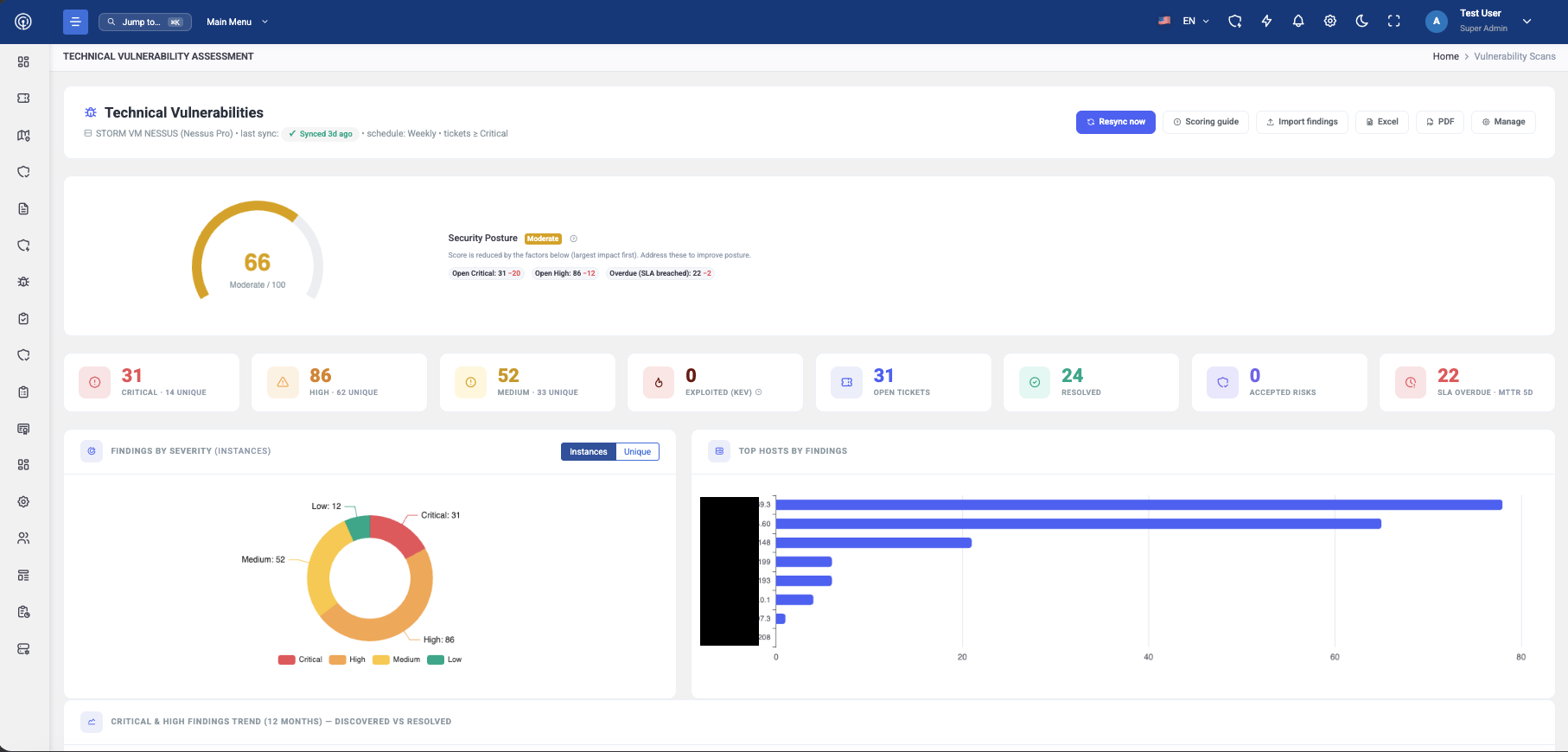
Aggregate results from vulnerability assessment sources and use interactive dashboards to monitor current posture, trends and remediation progress. Historical metrics help teams assess whether remediation performance is improving.
  • Multiple scanner and security-tool sources
  • Real-time posture, trend and progress dashboards
  • Historical remediation-effectiveness metrics
STORM Technical Vulnerabilities dashboard showing severity, KEV, ticket, resolution and SLA metrics
02 · Asset correlation

Give every finding operational context.

Link vulnerabilities to assets in the Risk Assessment Cartography Register. This creates a governed relationship between technical exposure and the services, systems or information represented by the asset model.

  • Cartography Register correlation
  • Shared asset context for prioritization
  • Centralized view across assessment sources
Built-in correlationFinding → Cartography asset
03 · SLA remediation

Route priority findings into accountable work.

Use severity rules to create and assign tickets, monitor remediation against service levels and track the workflow through resolution. Guidance can be presented where available rather than promised for every finding.

  • Automated tickets for specified severity levels
  • Assignment and SLA tracking
  • Remediation guidance where applicable
A
Ticket createdSpecified severity condition reached
Assigned
B
Remediation trackedOwner · target date · SLA progress
Active
C
Outcome measuredResolution history and performance metrics
Evidence
SLA workflow modelBuilt into STORM
04 · Exceptions and additional findings

Govern what cannot follow the standard path.

Manage exceptions and risk acceptance through approval workflows, and import findings from penetration tests or other activities using the spreadsheet template.

  • Exception and risk-acceptance approvals
  • Spreadsheet-based manual import
  • Support for penetration-test and other activity findings
01
Import findingsSpreadsheet template for additional sources
Imported
02
Request exceptionDocument the reason and approval path
Review
03
Record the decisionApproved exception or risk acceptance
Governed
Exception and import modelBuilt into STORM
From discovery to evidence

Keep every remediation step connected and measurable.

STORM manages the workflow around technical findings while the named scanners remain responsible for producing source results.

01

Collect

Scanner, tool or manual findings

02

Correlate

Link to Cartography assets

03

Prioritize

CVSS, severity and KEV

04

Assign

Ticket, owner and target

05

Track

SLA and remediation workflow

06

Measure

History and outcome metrics

Scope and delivery

What Vulnerability Management includes.

Validate sources, severity rules, SLAs and remediation ownership against the operational process you intend to run.

Included in STORM

  • Aggregation from vulnerability scanners and security tools
  • Tenable Nessus and Microsoft Defender integrations
  • Real-time posture, trends and remediation-progress dashboards
  • Correlation with Cartography Register assets
  • CVSS scoring and CISA KEV classification support
  • SLA, historical metrics and severity-based ticketing
  • Exception and risk-acceptance approval workflows
  • Spreadsheet import for penetration-test or other findings

Good to know

  • Additional scanner connectors on request
  • STORM prioritises vulnerabilities using CVSS scores, CISA KEV intelligence, and system business criticality, enabling risk-based remediation focused on the most critical threats.
  • Rescans and validation run in your scanner
  • Ticket destination and severity rules agreed at onboarding
Practical questions

Test the workflow against your actual finding volume.

Bring representative scanners, severities, asset records, SLA rules and exception cases to the product walkthrough.

Which vulnerability sources does STORM support?
Tenable Nessus and Microsoft Defender, plus aggregation from other scanners and security tools. Findings can also be imported through a spreadsheet template.
How are findings prioritized?
By CVSS score, CISA KEV intelligence and system business criticality, so remediation focuses on the most critical threats.
Can findings be connected to organizational assets?
Yes. STORM can correlate vulnerabilities with assets in the Risk Assessment Cartography Register, adding the asset relationship to the remediation workflow.
How does ticketing work?
STORM creates and assigns tickets automatically for the severity levels you choose, with workflow and SLA tracking.
Can penetration-test findings be included?
Yes. Penetration-test and other findings can be imported through a spreadsheet template.

Bring one scanner feed and one overdue critical finding.

Validate ingestion, asset correlation, severity logic, ticket assignment, SLA tracking and exception governance against the remediation process your teams already operate.

Book a STORM demo
Certifications

ICT PROTECT, the company behind STORM GRC, holds internationally recognised certifications and independent assurance.

View all certifications
  • CERTIFIED ISO 27001
  • CERTIFIED ISO 22301
  • CERTIFIED ISO 9001
  • CERTIFIED CYBER ESSENTIALS
  • CERTIFIED CYBER ESSENTIALS PLUS
  • ASSURANCE ISAE 3000 TYPE II

The certifications and assurance reports shown here are held by ICT PROTECT and apply within their stated scope, which includes the STORM GRC platform.